

|
Short answer Wheels leave marks because the tread material is too hard, contains colour-transfer rubber, or presses dirt into the floor surface. The solution: replace hard wheels or black rubber wheels with non-marking alternatives made from TPR, PU or grey elastic rubber. These materials roll softly, do not mark, and also protect sensitive floors such as parquet, laminate and PVC. |
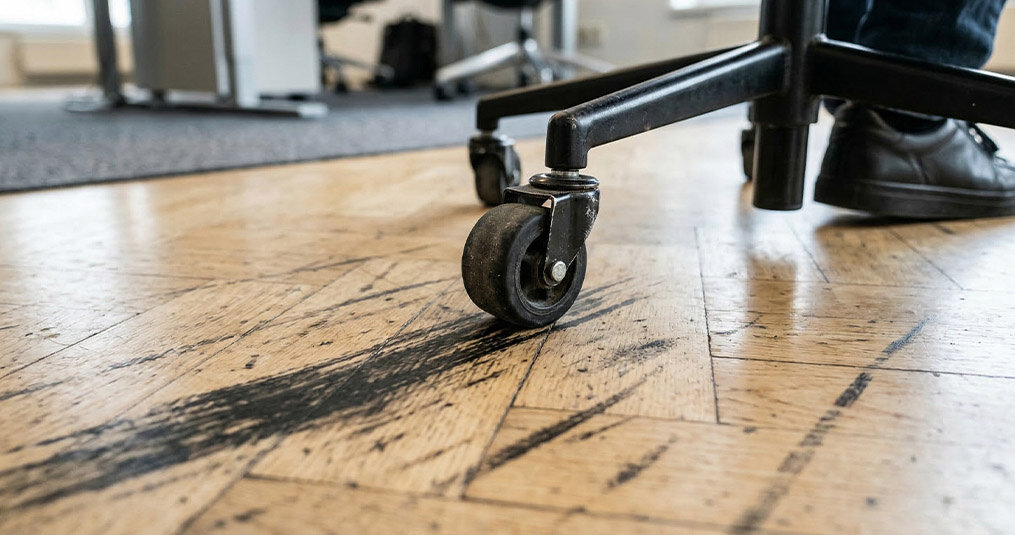
After a while, they start to appear: grey or black marks on your parquet, laminate or PVC floor. Sometimes barely visible, sometimes surprisingly wide. The cause is almost always the same: a wheel that is not suitable for indoor floors. In this article, you will read exactly why wheel marks occur, which floor types are most vulnerable, what you can do about it, and which non-marking wheels solve this problem permanently.
How do wheels cause marks and scratches on floors?
Not all wheels are the same. The material of the tread largely determines whether a wheel damages or protects your floor. There are five common causes of wheel marks indoors:
|
1. Standard black rubber Contains carbon black as a filler. This pigment transfers onto the floor during friction as black marks, the most common cause. |
2. Hard plastic (nylon, POM) Hard wheel edges scrape across the floor when turning sharply or tilting, causing scratches and dull patches. |
|
3. Dirt and sand in the tread Grains of sand or small stones trapped in a wheel act like sandpaper every time the wheel moves across the floor. |
4. Insufficient load capacity A wheel that is overloaded deforms and increases its contact area. As a result, the pressure on the floor rises. |
|
5. Aged or cracked rubber Old rubber dries out, cracks and leaves fragments behind. Inspect your wheels regularly and replace them in time. |
|
Which floors are most sensitive to wheel damage?
Parquet and laminate are particularly sensitive because the top layer is thin. PVC and resin floors quickly show black marks due to colour transfer from rubber. Vinyl flooring is relatively soft and can dent even under light loads. Other sensitive floors include resin floors (epoxy, polyurethane), marmoleum and lightly polished concrete.
Removing wheel marks is possible, but prevention is better
- Laminate & PVC: Try removing fresh black marks with a damp melamine sponge or a lactic-acid cleaner. Rub gently in the direction of the surface texture.
- Parquet: Use a soft cloth with a mild wood-oil cleaner. Do not sand, as this damages the finish. For deep scratches, sanding and refinishing is the only option.
- Resin floor: Black marks can sometimes be partly removed with acetone on a cloth, but always test on an inconspicuous spot first.
- Prevention is still better: No cleaning product removes deep scratches. Choose non-marking wheels before damage occurs.
The best wheels that do not leave marks
For indoor floors, three material types are especially suitable: TPR, PU and grey elastic rubber.
|
Quietest choice TPR wheels Thermoplastic rubber (TPR) is soft, cushioning and non-marking. It rolls whisper-quiet and leaves no traces. ✓ Soft and quiet ✓ No marks or colour transfer ✓ Ideal for parquet, laminate, PVC — Less suitable for heavy industrial loads |
Wear-resistant PU wheels Polyurethane (PU) is slightly harder than TPR but completely mark-free. It rolls smoothly and withstands intensive use. ✓ Wear-resistant and durable ✓ Smooth-running on laminate and PVC ✓ Higher load capacities available — Less cushioning than TPR on uneven floors |
Shock-absorbing Grey elastic rubber Softer than standard black rubber and fully non-marking. Extra shock absorption for sensitive equipment. ✓ Maximum shock absorption ✓ No black residue or marks ✓ Quiet and high-grip on smooth floors — Less suitable for rough concrete or heavy industry |
Which wheel type best suits your situation?
| Application | Floor type | Recommended wheel | Benefit |
|---|---|---|---|
| Furniture and chairs | Parquet, laminate | TPR | Soft, quiet, mark-free |
| Office chairs | Laminate, PVC | TPR or PU | Whisper-quiet, floor-protecting |
| Appliances / display cases | PVC, resin floor | PU | Smooth and wear-resistant |
| Worktables and trolleys | Laminate, concrete (smooth) | PU | Strong, durable |
| Flight cases, instruments | Parquet, vinyl floor | Grey rubber | Extra cushioning, no marks |
| Medical equipment | Resin floor, PVC | Grey rubber | Vibration-free and quiet |
What should you consider when choosing scratch-free wheels?
- → Frequency of use: daily movement calls for wear resistance, so choose PU. If movement is occasional, TPR is fine.
- → Weight of the object: heavier equipment needs wheels with a higher load capacity. PU is best suited to this.
- → Diameter: larger wheels handle thresholds more easily. Small wheels are more stable on flat floors.
- → Noise requirements: office or living space? Choose TPR or grey rubber, almost silent on smooth indoor floors.
- → Floor type: parquet and laminate require TPR or grey rubber. PVC and resin floors can also handle PU.
- → Vibration damping: equipment with sensitive contents (instruments, servers, audio) benefits from grey elastic rubber.
Frequently asked questions about non-marking wheels
Do you still have questions about wheels that leave marks on the floor? Below, we answer the most common questions about causes, solutions and choosing mark-free wheels.
Why does my wheel leave marks on the floor?
Marks occur because the tread material of a wheel is too hard, contains colour-transfer rubber, or presses dirt into the floor surface. Standard black rubber contains carbon black as a filler and is the most common cause of black marks on laminate, parquet and PVC floors.
Which wheels do not leave marks?
Wheels made of TPR (thermoplastic rubber), PU (polyurethane) or grey elastic rubber do not leave marks. These materials are non-marking and suitable for parquet, laminate, PVC and resin floors.
How do I remove black wheel marks from laminate or parquet?
Fresh black marks on laminate can often be removed with a damp melamine sponge or a lactic-acid cleaner. On parquet, use a soft cloth with a mild wood-oil cleaner. Never sand, as this permanently damages the top layer. Prevent it from happening again by choosing non-marking TPR or PU wheels.
What is the difference between TPR and PU wheels for indoor floors?
TPR wheels are softer and quieter, ideal for furniture and chairs on sensitive floors. PU wheels are slightly harder, more wear-resistant and better suited for equipment and worktables. Both do not leave marks.
Are soft scratch-free wheels also suitable for heavy loads?
Yes. Both TPR and PU wheels are available with high load capacities. Always choose a wheel whose capacity per wheel is comfortably above the actual load.
Which wheels are the quietest for indoor use?
TPR wheels are the quietest option. They damp vibrations and roll almost silently on parquet, laminate and PVC. Grey elastic rubber offers extra shock absorption for spaces where noise must be kept to a minimum.
Are scratch-free wheels also suitable for resin floors?
Yes. TPR and PU wheels do not mark and do not damage the surface. For sensitive equipment on a resin floor, grey elastic rubber is the best choice because of its extra vibration damping.
|
Ready to protect your floor? View our most popular series of non-marking wheels. Suitable for every indoor floor and application. M-series MZ-series GR-series |